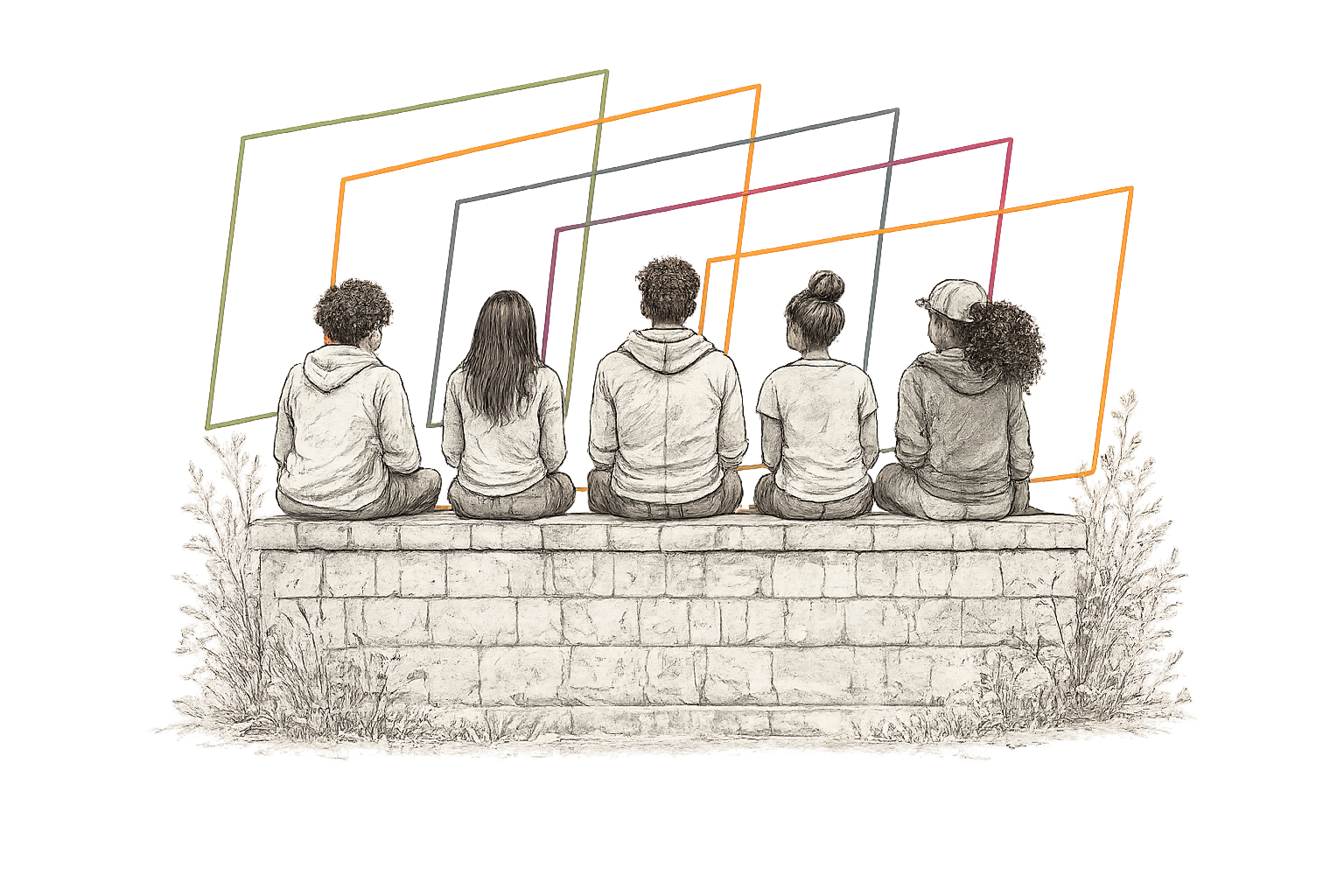
Added to your portrait
We often ask whether young people have purpose. We rarely ask whether the conditions around them allow it to be seen and supported.

This asymmetry can impose a deficit framing of young people as missing something, while leaving programs, institutions, and relationships that shape their development unexamined. This exchange invites seeing youth purpose through a broader set of lenses.

Start Here

Build a clearer portrait of youth purpose

Move through a small set of reflective studios. Each contribution adds to your own portrait while helping surface broader patterns in how young people experience purpose across contexts and communities.

Portraits of Purposeful Youth is an open and collaborative project created by the Purpose and Identity Processes Lab and hosted in partnership with the Purpose Science and Innovation Exchange (PSiX) at Cornell University.

No single measure, moment, or characteristic can fully capture the complexity of a young person’s purposeful life.

Portraits of Purposeful Youth explores how purpose takes shape across identities, experiences, relationships, and environments. Inspired by developmental science and many impactful and generative “portrait” initiatives in education and youth development, the project invites a broader and more human view of how purpose is expressed, supported, and understood.

Your responses here matter because they do three things: they build a private portrait you can keep, they surface public-facing contributions for review, and they help create an aggregate view of what different people notice about youth purpose.

Choose one or more roles

The exchange needs different things from different people. Pick your vantage point(s).

Add two quick notes

These notes travel with your portrait and help shape the summary you receive at the end.

Saved to the exchange.
1. Role-based signal

A visualization of how others who share a similar role frame what they notice about youth purpose.

2. Interpretive synthesis Sample

A sample narrative generated from your role and early responses, designed to preview the kind of synthesis this exchange can produce.

3. Your private portrait record

Download a clean recap of what you entered here, or open an email draft to yourself. Public-facing contributions remain separate and reviewable.

Portrait Studio Choose one focused workspace at a time.
The Claim
A sense of purpose is not distributed evenly across young people. It is cultivated or constrained by the unique set of conditions that surround them.

This is a claim with evidence behind it. Purpose — a self-organizing and forward-looking life aim — is a developmental resource. Substantial research links it with a host of health and well-being benefits for those who cultivate it. But it does not emerge by chance. It grows in relation to what young people can see, what they are given the chance to do, who recognizes them, and what their environment makes possible.

Tuning how purpose is seen What sharing your perspective can impact:

  • What researchers study — shifting from traits and scores to mechanisms and conditions
  • What practitioners build — designing environments that actively cultivate purpose
  • What policymakers fund — holding institutions accountable for creating conditions that support purposeful development
  • Who is seen as purposeful — recognizing that constrained purpose often reflects constrained conditions, not constrained potential
Takeaway · Set your lens

Use the sliders to show what you tend to notice first when thinking about youth purpose. Higher numbers mean that part of the picture is more visible to you right now.

55field of view

Now choose where you would look first if a young person’s purpose seemed out of focus.

Your Working Definition

Define purpose here to inform what to look for in the portraits.

Carry a working definition into the rest of the exchange. It does not need to be polished. We are interested in the words you are operating with right now.

Saved to the exchange.
What we see and what we do
If purpose develops in conditions,
then what we understand about purpose
must engage with those conditions.

Seeing youth purpose more clearly should shape what we ask about, what we build to support it, and what we stop overlooking when we shift our perspective.

Takeaway · Your next move

When you see purpose arise for a young person, what would you do next?

This completes the “next move” item in your portrait. Pick the response you would most likely make from your selected role perspective.

The Framework

Introducing the Portraits of Purposeful Youth Framework:
Eight Lenses of Purposeful Experience

01
Sense of Purpose
02
Scope and Awareness
03
Orientation
04
Content
05
Opportunities for Practice
06
Recognition and Reflection
07
Environmental Affordances
08
Cultural Context

The portraits framework is organized around eight interconnected "lenses" designed to see purpose from multiple vantage points. These lenses span personal, experiential, relational, and contextual domains, recognizing that purpose is shaped not only by individual beliefs and motivations, but also by opportunities, environments, relationships, and cultural signals.

Each lens is grounded in developmental science while remaining open to revision, critique, and expansion. Rather than offering a single definition of purposeful youth, the framework seeks to create a more flexible and integrative array of portraits, each capable of capturing how young people experience purpose in their lives. There may be no best way to see purpose; instead, there may be numerous ways by adjusting and combining the lenses through which we chose to view them.

Explore the lenses actively. As you read, flag the lenses that resonate. Those choices will be tallied and translated into stacked color frames in your final portrait.

Your resonant lens frame

No lenses flagged yet. Use the “Resonates” flags on the cards below to build a visual frame for your portrait.

Epistemic status:
Research-grounded
Actively developing
Empirically emerging
01 · Inner Experience
Research-grounded
Sense of Purpose
How purposeful one feels. The subjective experience of perceiving that one's actions carry meaning and direction, the felt sense of purpose, distinct from being able to articulate or explain it.
+ What to look for in practice
In practiceDoes this young person report that what they do matters? Do they express a sense of drive or direction — even without words for it? Is there something they return to, even when it's hard?
02 · Inner Experience
Actively developing
Scope and Awareness
What a young person can imagine, see, or name as possible targets for purpose. The horizon of possibility — the range of lives, roles, and forms of contribution they can conceive of for someone like themselves.
+ What to look for in practice
In practiceCan this young person name roles, causes, or futures they care about? Has their horizon expanded over time, or stayed fixed? Constrained scope often reflects constrained exposure — not constrained capacity.
03 · Inner Experience
Research-grounded
Orientation
The broad domain or general direction that frames a young person's purpose — whether prosocial, financial, vocational, religious, civic, creative, or otherwise. Orientation names the general category of contribution or becoming that organizes how they see themselves in relation to the world.
+ What to look for in practice
In practiceDoes this young person have a general sense of what kind of contributor or person they want to become — even without a specific aim yet? Is their orientation toward serving others, building something, achieving mastery, or following a calling? Orientation can be present before specific goals form.
04 · Inner Experience
Actively developing
Content
The specific aspirational substance of what a young person understands they want to work toward. Not just a broad orientation, but a particular aim: being a great student, helping advance an important issue, mastering a craft, building something that matters. The articulation — even if partial or evolving — of what their purposeful effort is actually directed at.
+ What to look for in practice
In practiceCan this young person name something specific they want to do, become, or contribute — not just a general domain? Has that aspiration grown more concrete over time? Even a vague but genuine aim ("I want to do something with the environment") is purposeful content worth developing.
05 · Active Engagement
Actively developing
Opportunities for Practice
Concrete chances to explore, try, and enact purposeful action. Not just exposure — genuine opportunities to act, contribute, and experience oneself as a capable agent in something that matters beyond the self.
+ What to look for in practice
In practiceDoes this young person have regular, authentic chances to act on what they care about? Are those opportunities real — with stakes and impact — or performative? Who controls access to them?
06 · Active Engagement
Research-grounded
Recognition and Reflection
Feedback, validation, and structured sense-making from oneself and others. The relational and reflective processes through which purposeful experience becomes visible, interpreted, and integrated into identity.
+ What to look for in practice
In practiceDo adults and peers name and affirm what this young person contributes? Are there structured opportunities to reflect and extract meaning? Is this young person developing a narrative of their own purposeful identity?
07 · Conditions
Actively developing
Environmental Affordances
Material, social, and institutional resources that make purposeful action possible. The structures, spaces, and relationships that either enable or foreclose what a young person can do with what they care about.
+ What to look for in practice
In practiceWhat resources does this young person have access to? Who gatekeeps them? Are the environments this young person inhabits designed with purposeful development in mind — or does it happen despite the design?
08 · Conditions
Empirically emerging
Cultural Context
The sociocultural signals — explicit and implicit — about what kinds of purpose are valued, legitimate, and possible in a given context. The messages a young person receives about who gets to pursue purpose, and what kinds count.
+ What to look for in practice
In practiceWhat does this environment communicate about whose futures matter and which forms of contribution are worth pursuing? Are cultural norms expanding or narrowing what this young person believes is possible for someone like them?
?? · Your nomination
Community proposal
Nominate a Lens
Is there a dimension of purposeful experience that the eight lenses above don't capture? Name it here. Strong nominations will be considered for inclusion in future iterations of this framework — and posted here for community feedback.
Reading a purposeful experience

Which cue do you attend to the most?

Purpose can show up in different ways. Put these cues in the order you would use when trying to understand a young person’s purposeful experience. There is no right order; the point is to show how you look.

Build your detection order

Move the cues up or down. The top cue is what you would look for first; the note below explains what that order helps you notice.

Community Pulse
Which lenses should be focal?

This is merely a signal of your curiosity, not a poll attempting to draw scientific inference. Choose the lense(s) that you think should be the focus of research and practice. Your responses can help guide approaches for learning more about the areas of greatest interest

This month's question
Which lenses are you most interested in, and want to know more about?
Thanks — your response is reflected in the pulse.
Open Questions

What do you still want to know?

These are genuine open questions, not rhetorical ones. The invitation is to help us sharpen them, challenge them, or add the question that should have been here from the start.

This section will grow as the exchange develops. The questions below are starting points; the most useful contribution may be naming the better question.
Questions the research community can address
How do the eight lenses interact with each other? Is there a developmental sequence, or do they operate in parallel?
+ Contribute to this question
When adults say a young person “lacks purpose,” what are they actually failing to notice?
+ Contribute to this question
Questions practitioners can surface from the field
How do you support Scope and Awareness with young people navigating genuinely constrained futures — without setting them up for harm?
+ Contribute to this question
Which lens breaks down first in under-resourced settings? What does the sequence of constraint look like in practice?
+ Contribute to this question
Questions only young people can answer from the inside
What does Resonance actually feel like when it's present — and what does its absence feel like, from the inside?
+ Add a quick sighting
When purpose feels constrained, what do the adults and institutions around you most get wrong?
+ Add a quick sighting
Add a question to this board
Have a question that would help others see youth purpose more clearly? Submit it here. Strong questions can inform this board and the Seeing Prompts collection.
Thank you — your question has been received for review.
The Exchange

Share what you're seeing

Share a fuller reflection or leave a prompt for seeing purpose in young people more clearly. Your insights may help others see things differently than what is typical for them.

Your private entries are captured in your portrait; selected public-facing pieces can also inform reviewed aggregate views of what the community is noticing.

Add your contribution
You are contributing from your selected role perspective.
Seeing prompts — one useful question Complete the prompt at right with a question you could actually ask a young person. Your response is added to your portrait.
Seeing prompt
Your Portrait Reveal

Produce your Portrait of Purposeful Youth

This is the portrait you have been building. It pulls together your role, definition, lens settings, reading order, questions, reflections, and seeing prompts into one shareable view of how you are seeing youth purpose.